
Udaipur — Jaipur — Destination — Sagai to Vidaai
Rajasthan royal wedding photography, every ritual documented
From the Sagai to the Vidaai, candid coverage of royal Rajput and Marwari rituals, in a fort, a haveli, or wherever your wedding takes you.
Contact Us →Every ritual, covered
A Rajasthani wedding is built for grandeur — a groom arriving on a decorated horse or elephant, a sword striking a flower-laden Toran, turbans and jootis and jadau jewellery under palace lights. But underneath the scale, it’s still built from deeply personal rituals: a mother’s tilak, a mama’s procession of gifts, a bride’s veil lifted just partially during her seven vows. At Yatish Photography, we photograph Rajput and Marwari weddings — royal in scale, whether hosted in a Rajasthan fort, a heritage haveli, or as a destination wedding in Bangalore — with equal attention to the spectacle and the quiet moments hiding inside it.
Rajasthani wedding customs shift between Rajput and Marwari communities in small but meaningful ways — the number of pheras taken at the mandap, whether Janeu is performed, how the Baraat departs — and we plan our coverage around your family’s specific version of these rituals rather than a generic “royal Indian wedding” template.
Every Ritual of a Rajasthani Royal Wedding
Sagai — The Formal Engagement
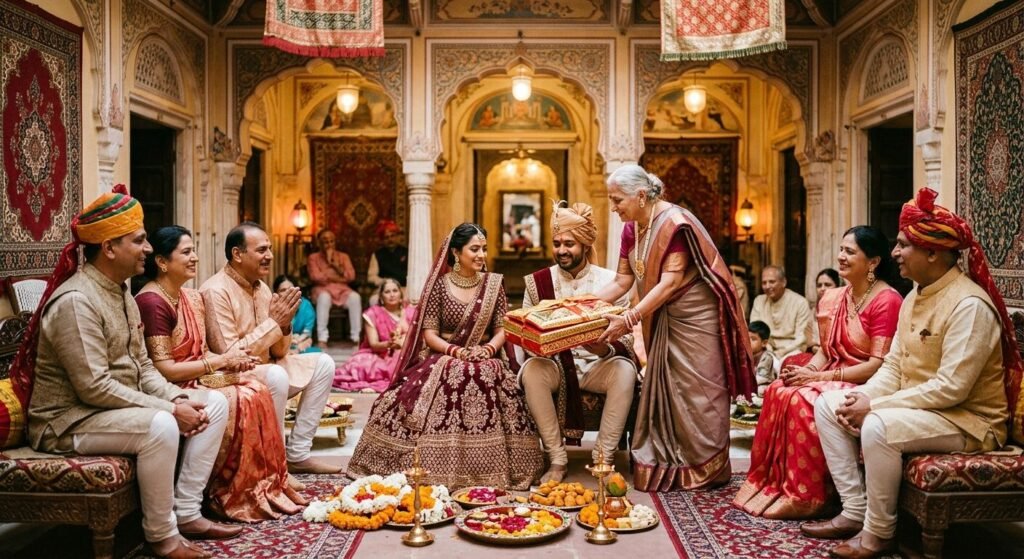
The Sagai is the formal engagement ceremony, where families exchange gifts and blessings to confirm the alliance, often accompanied by a small puja and the exchange of a ring or sacred thread. It sets the tone for everything that follows — measured, dignified, and steeped in family protocol. We photograph the Sagai with attention to the formal gestures that carry meaning in Rajasthani households: the specific order in which elders bless the couple, the presentation of gifts, the first formal photograph of the two families together.
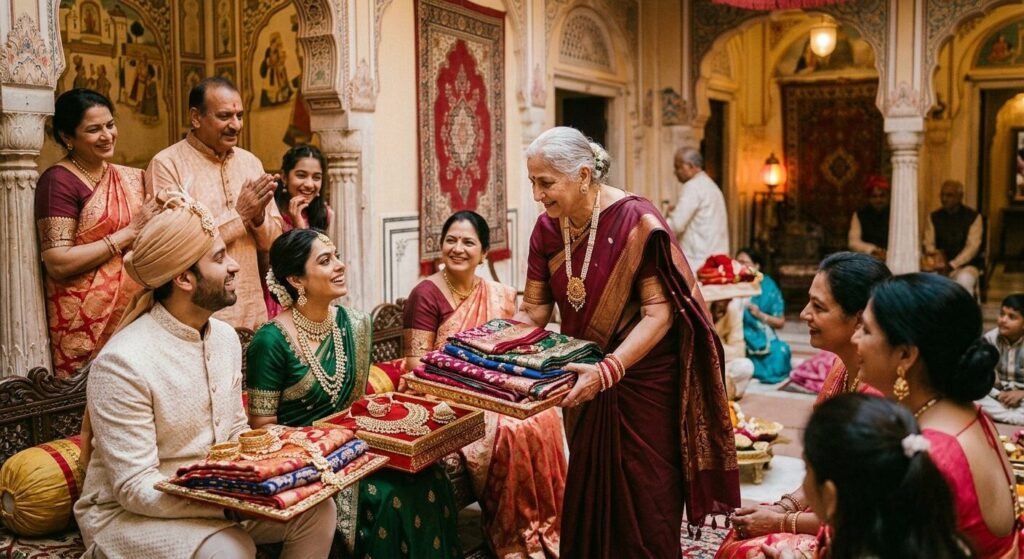
In the Palla Dastoor, representatives of the groom’s family visit the bride’s home carrying elaborate trousseau trays of clothing, jewellery, sweets, and fruit, which the bride is traditionally expected to wear at points during the wedding itself. The gifts are displayed publicly in the home for relatives to admire, making this as much a social occasion as a ritual one. We treat the Palla Dastoor as a genuine styling and detail shoot — the trays themselves, the specific jewellery pieces, the bride’s reaction on seeing them — since these images often end up being reused for save-the-dates and wedding websites.
Palla Dastoor — The Groom's Family Bears Gifts
Mayra — The Maternal Uncle's Procession
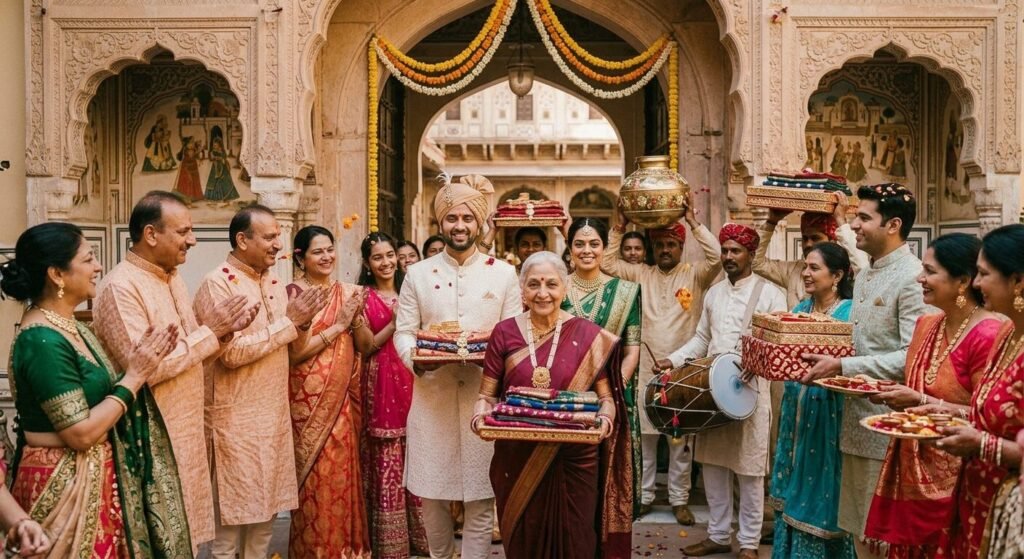
A ritual distinctive to Rajasthani weddings, the Mayra involves the bride’s maternal uncle (mama) arriving with an elaborate procession of gifts for the bride and her family, celebrating the maternal side’s involvement and support. It’s a joyful, often musical occasion, with the mama’s arrival treated as a small event in itself. We cover the Mayra as a procession shot first — the arrival, the gifts being carried in — and then move into closer, more intimate framing as the gifts are formally presented indoors.
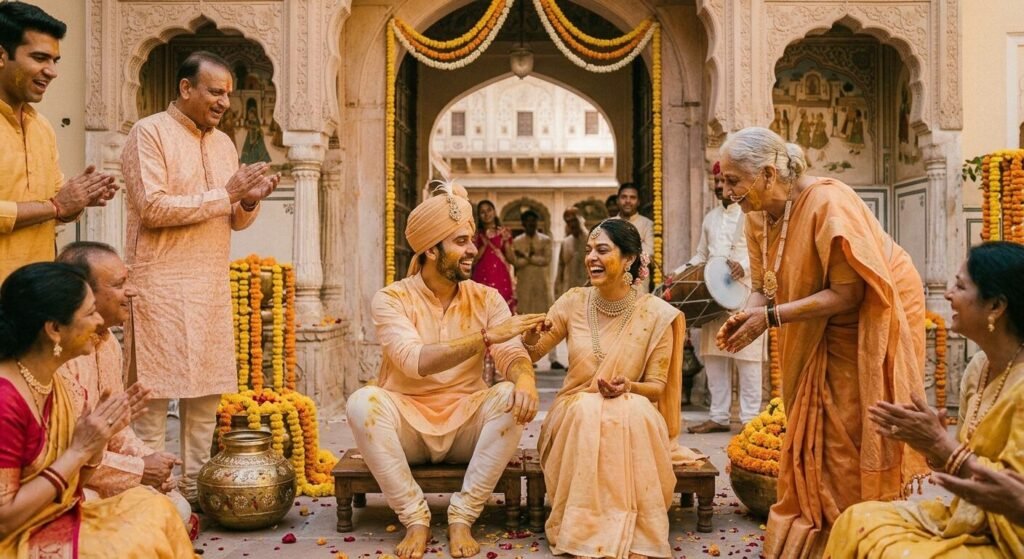
The Haldi, sometimes referred to locally as Ubtan, involves applying a turmeric and sandalwood paste to the bride and groom at their respective homes, believed to bless them with health and a glowing complexion before the wedding. As in most North Indian traditions, it’s a lively, informal event, often held outdoors with music and dancing woven through it. We shoot Haldi candidly, prioritising genuine reactions over posed application shots, since this is one ritual where the mess and the laughter are the actual story.
Haldi and Ubtan — Turmeric and Blessings
Mehndi and Ghoomar — Henna and the Circular Dance
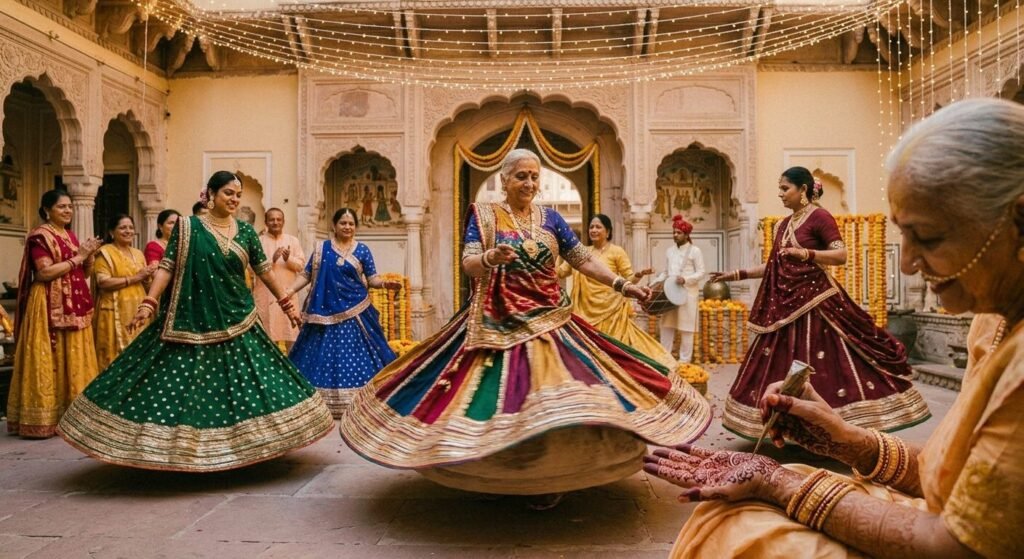
The Mehndi ceremony sees intricate henna patterns applied to the bride’s hands and feet, often taking hours, while women perform the Ghoomar — a traditional Rajasthani circular folk dance characterised by swirling movements and flared, colourful lehengas — around her. Between the detail of the henna work and the visual spectacle of Ghoomar in full swing, this is one of the richest photographic opportunities of the entire wedding. We split our coverage between macro shots of the henna artistry and wide, dynamic shots of the dancing, timed to catch the lehengas mid-spin.
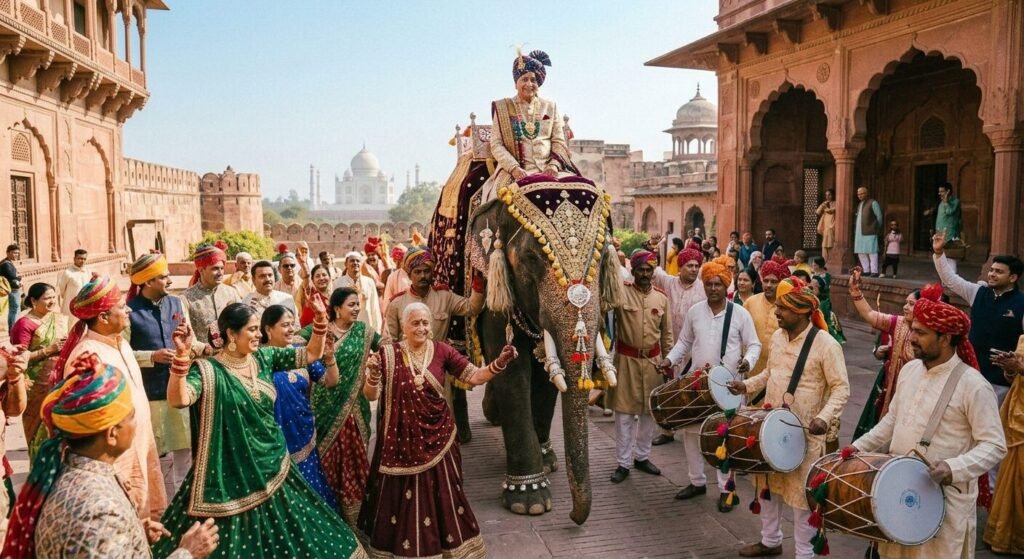
Before departing, the groom performs the Nikasi — visiting a temple for blessings, having kajal applied by his sister-in-law to ward off the evil eye, and having a golden thread tied to his horse or mount for good fortune — before the full Baraat procession, often featuring a decorated horse, elephant, or vintage car, sets off toward the venue accompanied by dancing family, friends, and a live band. This is the most visually spectacular ritual of the wedding, and we cover it in two distinct phases: intimate, close coverage of the Nikasi preparations at home, followed by wide, high-energy shots of the procession itself, capturing both the scale of the event and the groom’s expression as he approaches the venue.
Baraat and Nikasi — The Groom's Grand Departure and Arrival
Toran and Aarti — Striking the Threshold
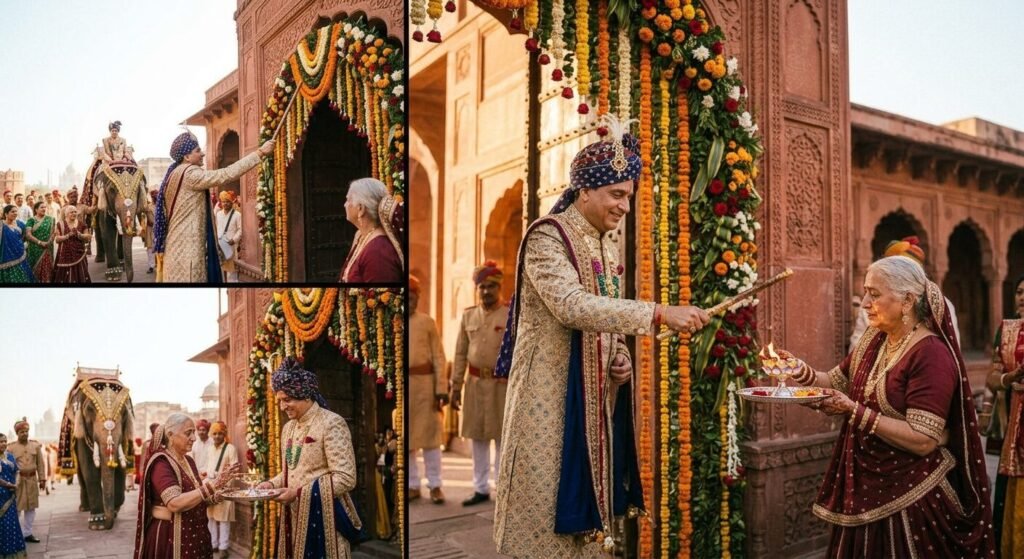
On arrival at the venue, the groom strikes the Toran — a decorative arch, traditionally hit with a sword or a neem stick — as a symbolic warding off of evil and formal claim to the alliance, after which the bride’s mother welcomes him with an aarti and a tilak, sometimes followed by a playful attempt to pull his nose as part of the ceremony’s lighter traditions. This is a fast-moving, detail-dense ritual, and we position ourselves in advance to capture the strike itself, the aarti, and the tilak in sequence, since each happens within moments of the other.
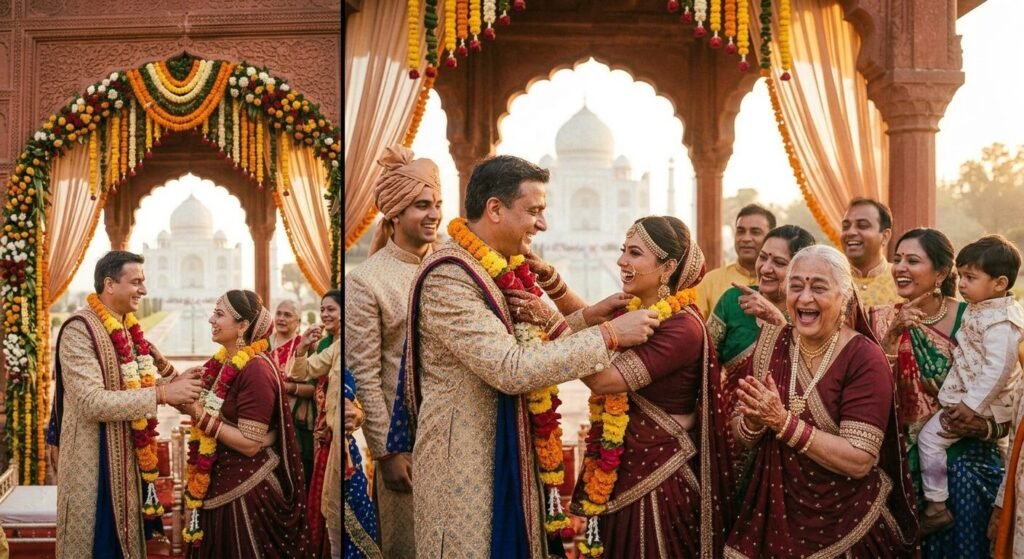
In the Jaimala, the bride and groom exchange floral garlands, signifying their mutual acceptance of one another as the ceremony moves toward its ceremonial core; in some Rajasthani traditions, this is preceded by the bride circling the groom three times while showering him with flower petals before the exchange itself takes place. It’s often a slightly playful moment, sometimes involving family members good-naturedly lifting the bride or groom to make the garlanding harder — and we’re ready to capture that humour rather than only the formal exchange.
Jaimala — The Exchange of Garlands
Kanyadaan and Pheras — The Sacred Vows
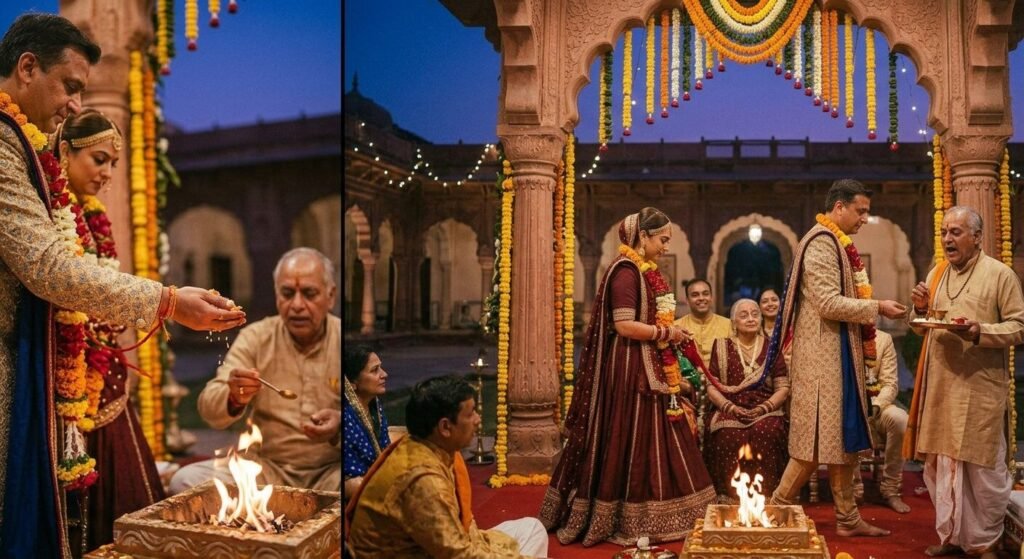
The Kanyadaan sees the bride’s father formally giving her hand to the groom, followed by the Pheras, where the couple circles the sacred fire while a priest chants Vedic mantras — in many Rajasthani weddings, four rounds are taken at the mandap itself and the remaining rounds completed later at the threshold of the bride’s new home, a structure that differs from the more familiar seven-in-one-place format seen elsewhere in North India. Throughout the Pheras, the bride’s ghunghat is often kept partially lifted, a detail specific to Rajasthani tradition that we make sure to note and photograph respectfully. We shoot this sequence with minimal movement and no flash, capturing each round individually rather than only a wide shot of the fire.
The groom applies sindoor to the bride’s forehead in the Sindoor Daan, marking her new status as a married woman, while the Gathjoda — a ceremonial knot tying the groom’s turban cloth to the bride’s garment — symbolises their eternal bond as they complete their vows together. These are quiet, close-up moments amid the grandeur of the wider ceremony, and we treat them with the same stillness and respect we bring to the Pheras themselves.
Sindoor Daan and Gathjoda — Marking the Marriage
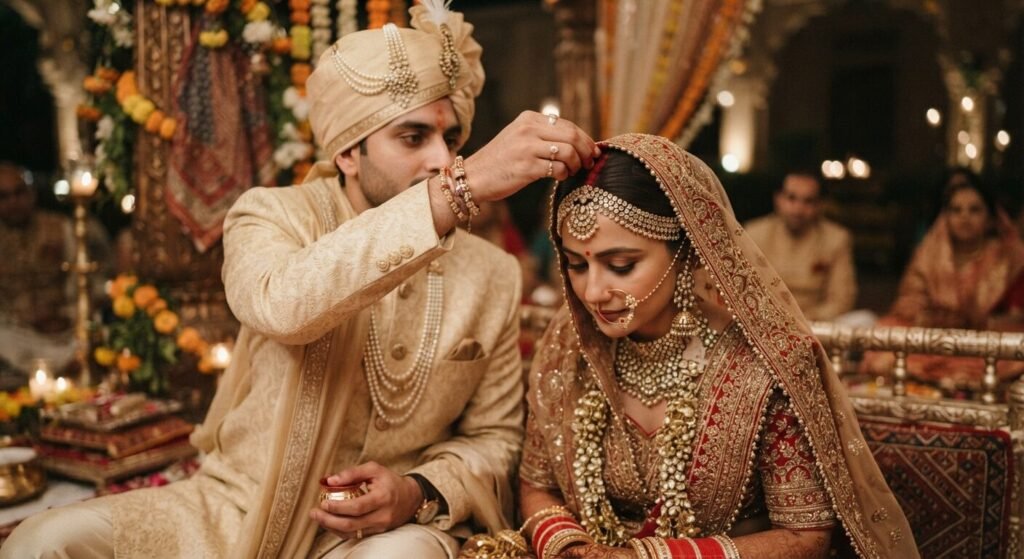
Vidaai — The Emotional Farewell
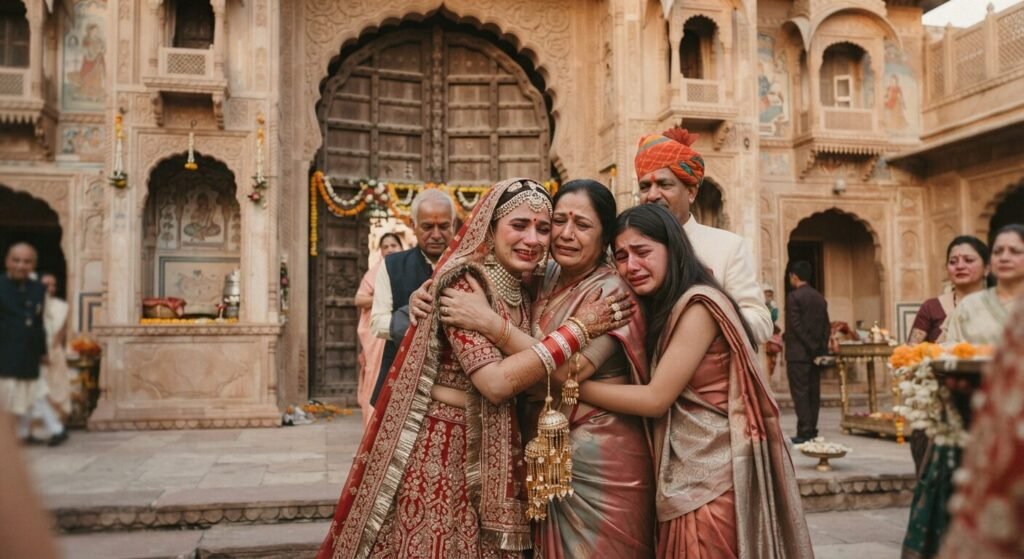
The Vidaai marks the bride’s departure from her parental home, with her family offering final blessings, often amid visible tears, before she leaves to begin her new life — widely considered the most emotionally significant moment of any Indian wedding, and Rajasthani weddings are no exception. We photograph the Vidaai exactly as we do in every tradition we cover: no direction, no second takes, simply documenting the goodbye as it happens.
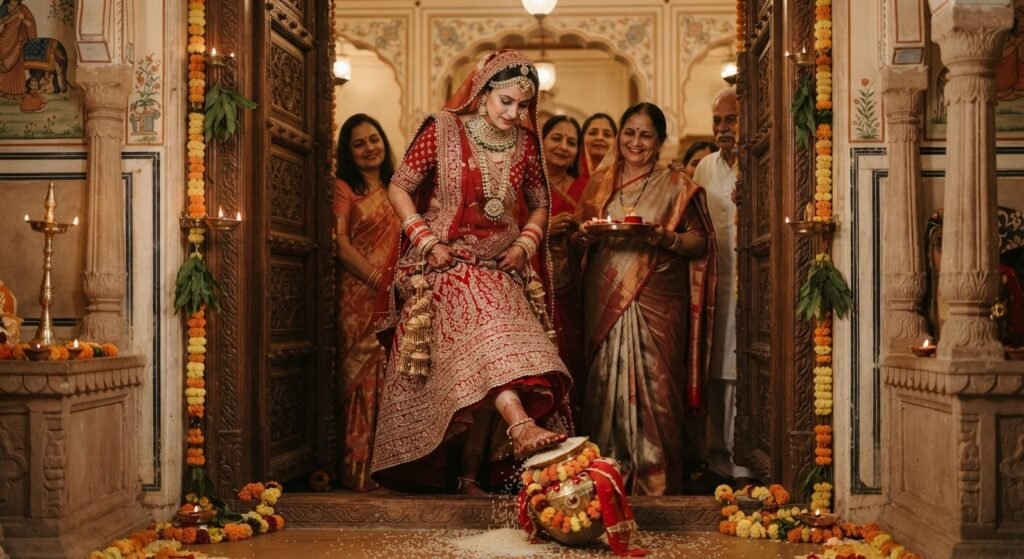
After the wedding, the Griha Pravesh welcomes the bride into her new home, traditionally involving her tipping over a vessel of rice with her right foot to symbolise prosperity, while the Pag Phera — the bride’s first visit back to her parental home, usually three to five days later — marks the formal conclusion of the wedding celebrations with a small family feast. We recommend including both in your coverage plan, since together they close the story that began with the Sagai.
Griha Pravesh and Pag Phera — Homecoming and Return
Our Approach to Rajasthan Royal Wedding Photography
Rajasthani weddings combine genuine scale with genuine intimacy, and our coverage is built to serve both:
- Community-specific accuracy — we confirm in advance whether your family follows Rajput or Marwari customs, since details like the number of pheras and the presence of rituals like Janeu vary between them.
- Built for spectacle — from the Baraat’s grand entrance to Ghoomar in full motion, we bring wide, high-energy coverage for the moments designed to be seen at scale.
- Built for stillness too — the Sagai, the Kanyadaan, the Sindoor Daan, and the Vidaai get the same quiet, respectful, minimal-intervention treatment regardless of how large the wedding around them is.
- Palace and heritage venue experience — we’re comfortable working within the lighting and logistical constraints of forts, havelis, and heritage properties across Rajasthan.
- Destination-ready — for Rajasthani families hosting weddings outside the state, including in Bangalore, we bring the same cultural specificity to the coverage wherever the event takes place.
What Couples Say
Frequently Asked Questions
Do you photograph both Rajput and Marwari weddings?
Yes, and we confirm the specific customs your family follows in advance, since details like the number of pheras taken at the mandap, the presence of the Janeu ceremony, and the structure of the Baraat can differ meaningfully between the two.
Can you travel to Rajasthan for a destination wedding?
Yes, we regularly travel to fort and heritage venues across Rajasthan, and we plan our equipment and lighting approach around the specific architecture and constraints of palace and haveli locations.
Do you cover Rajasthani weddings hosted outside Rajasthan?
Yes — many Rajasthani families now host weddings in cities like Bangalore, and we bring the same ritual-specific coverage regardless of where the event is held.
How do you handle the scale of a large Baraat procession?
We plan positioning in advance for the Nikasi, the procession itself, and the Toran and Aarti sequence at arrival, since these happen quickly and in a specific order that’s easy to miss without preparation.
How soon after the wedding do we receive our photos?
Edited previews are typically shared within a few days, with the full gallery delivered on a timeline confirmed in advance based on the scope of the coverage.
Ready to Document Your Royal Rajasthani Wedding, Ritual by Ritual? Let’s Talk.