
Punjabi wedding photography, every ritual documented
From the Roka to the Doli, candid coverage of a wedding that never really stops moving.
Contact Us →Every ritual, covered
A Punjabi wedding is not one event — it is a week-long celebration built from a dozen smaller ones, each with its own music, its own colours, and its own kind of emotion. There is the quiet nervousness of the Roka, the noise and laughter of the Sangeet, the tears at the Doli, and everything loud and joyful in between. At Yatish Photography, we specialise in candid Punjabi wedding photography and cinematic wedding films for couples in Bangalore and across India, built around one simple idea: every ritual deserves to be documented the way it actually happened, not staged for a camera.
We’ve spent years learning the rhythm of Punjabi weddings — where to stand during the Milni so we don’t block the moment, how to read a room during the Anand Karaj, when to stay completely out of the way during the Doli so the goodbye stays real. That experience is what separates documentation from decoration.
Every Ritual of a Punjabi Wedding
Roka and Thaka — The Beginning
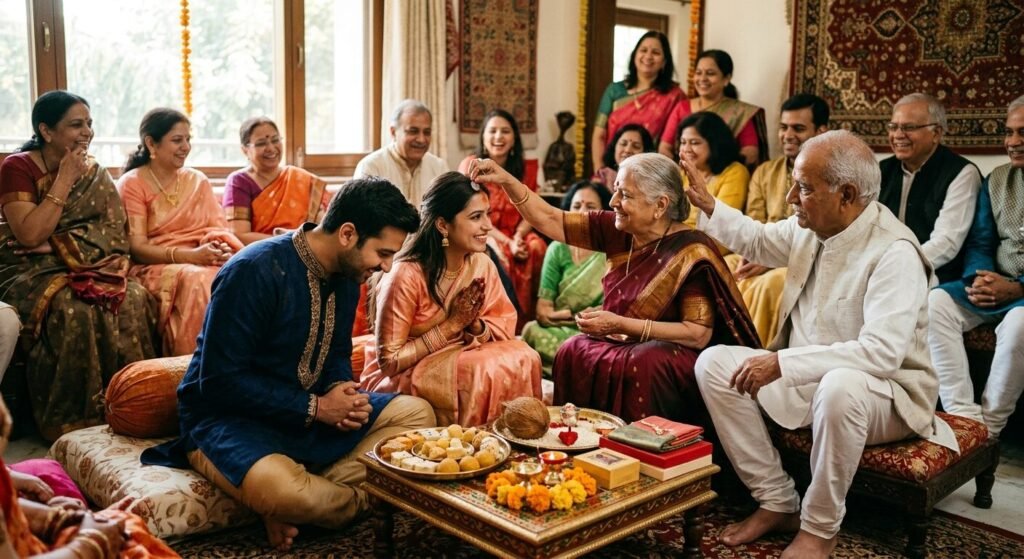
The Roka is often the first formal step, a small, intimate gathering where both families come together to confirm the match, usually before a larger engagement is even planned. It’s typically low-key — sweets are exchanged, elders bless the couple, and there’s a warmth in the room that’s very different from the scale of later events. We treat the Roka as a candid, documentary-style shoot: soft natural light, close framing on hands being held, on parents seeing their children’s future partner for the first time. These are the photographs families tend to return to years later, because they capture the moment the story actually began.
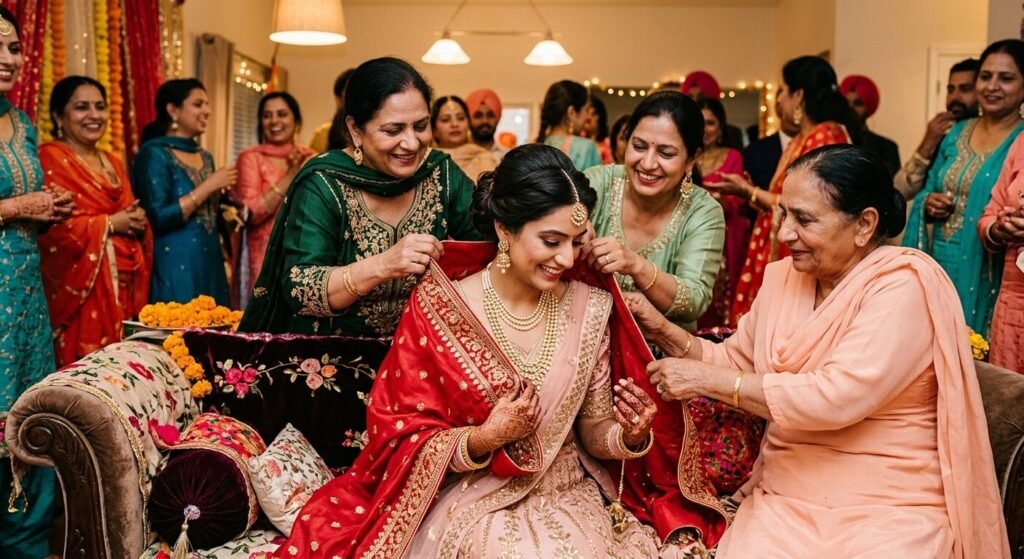
The Sagan (engagement) and the Chunni ceremony, where the groom’s family presents the bride with a red chunni, jewellery, and gifts, mark the formal beginning of the wedding proceedings. This is often the first time both families are dressed up together, and it’s rich in ritual detail — the tilak on the groom’s forehead, the exchange of rings, the bride’s family welcoming the groom’s side with aarti. We shoot this with an eye for the small ritual gestures that are easy to miss in the moment: the tray of sweets, the specific way the chunni is draped, the first shared smile between the couple as the families finalise the union.
Sagan and Chunni Ceremony — Formalising the Bond
Mehndi — Colour, Craft, and Chaos
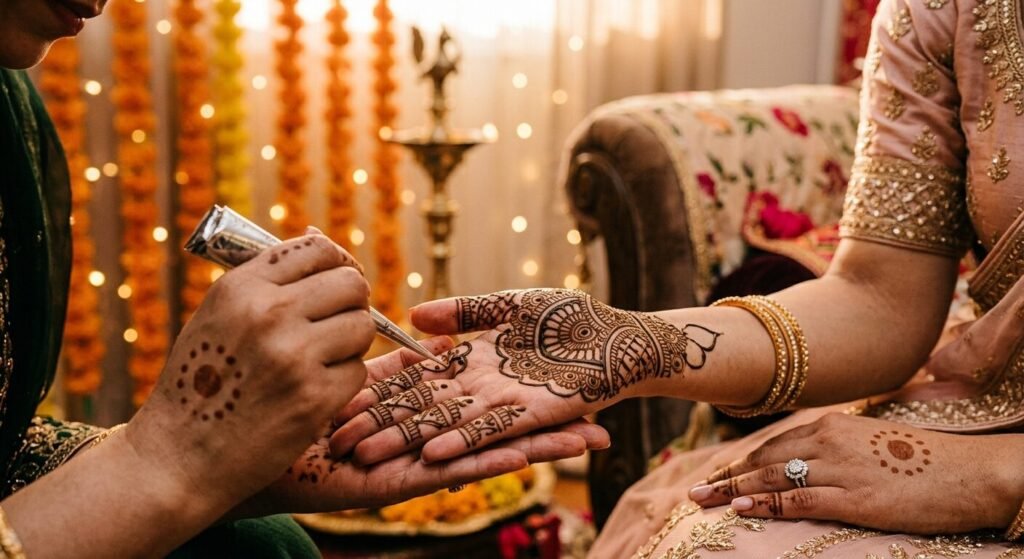
The Mehndi ceremony is one of the most visually rewarding parts of any Punjabi wedding. Intricate henna patterns are applied to the bride’s hands and feet, often taking hours, while the mehndi artist works and the bride’s friends and cousins sing, dance, and tease her about married life. The décor tends to be vibrant — marigold strings, yellow and orange fabric, string lights — and the mood is relaxed compared to later, more formal events. We shoot Mehndi with a mix of macro detail shots (the henna patterns themselves, the bride’s expressions as she sits still for hours) and wider candid coverage of the dancing and games that inevitably break out around her.
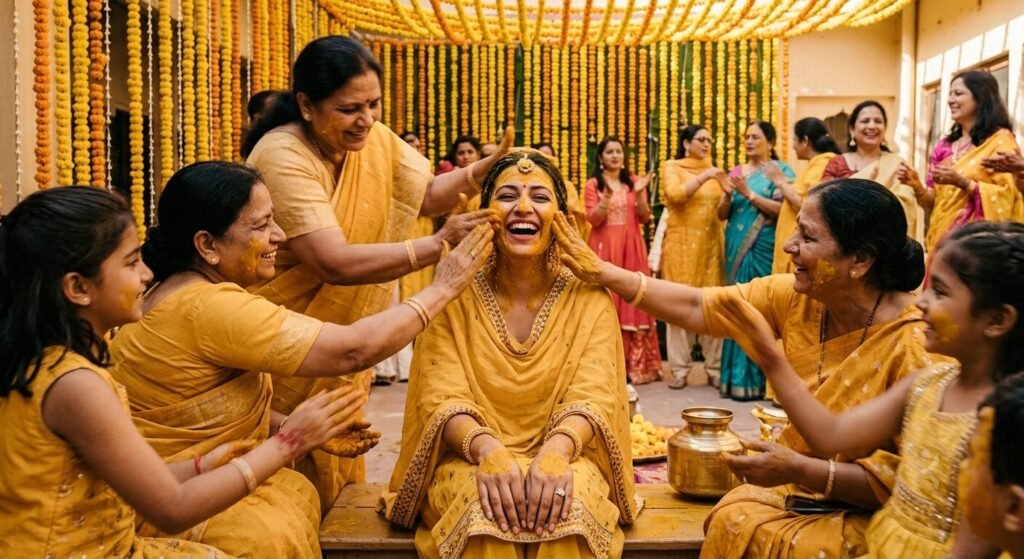
The Haldi (turmeric) ceremony, sometimes called Vatna in Punjabi households, involves applying a paste of turmeric, sandalwood, and mustard oil to the bride and groom, usually at their respective homes, as a blessing for glowing skin and good fortune. It’s playful and a little messy — turmeric paste ends up everywhere, family members take turns applying it, and there’s a lot of laughter as things inevitably get chaotic. We photograph Haldi candidly and up close, favouring genuine reactions — the wincing, the giggling, the mock protests — over posed shots, because that’s what actually makes these photos feel alive years later.
Haldi and Vatna — Blessings Before the Big Day
Ghara Gharoli — A Quiet Ritual Often Missed
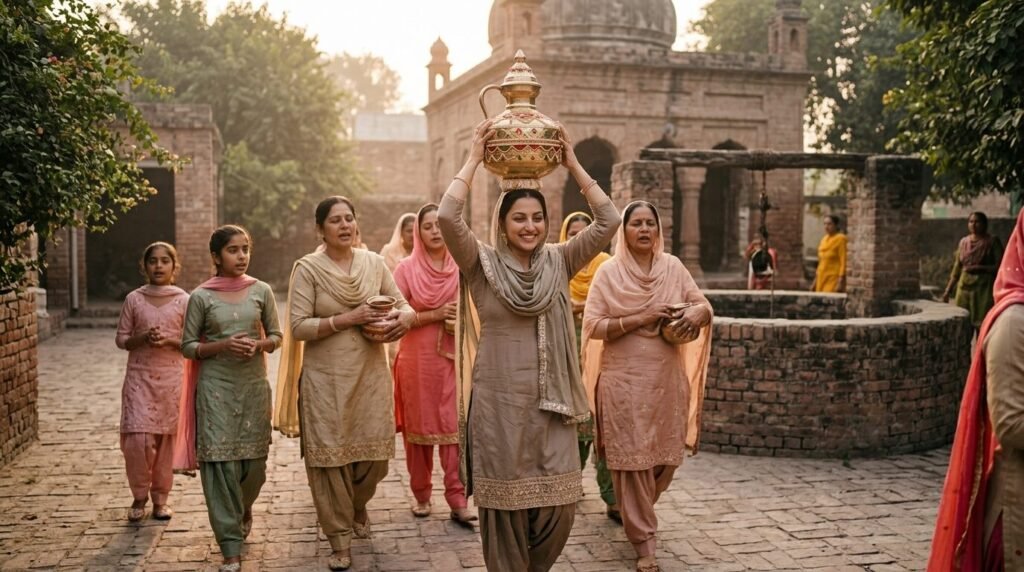
Less commonly photographed but deeply meaningful, the Ghara Gharoli involves the bride’s sisters-in-law or close female relatives fetching water from a well or temple in a decorated pitcher, which is then used for the bride’s ceremonial bath. It’s a quieter, more intimate ritual, usually attended by a smaller group of women, and it carries a lot of symbolic weight around purity and new beginnings. We make a point of covering this ritual even when it isn’t explicitly requested, because it’s often one of the moments families are happiest we captured.
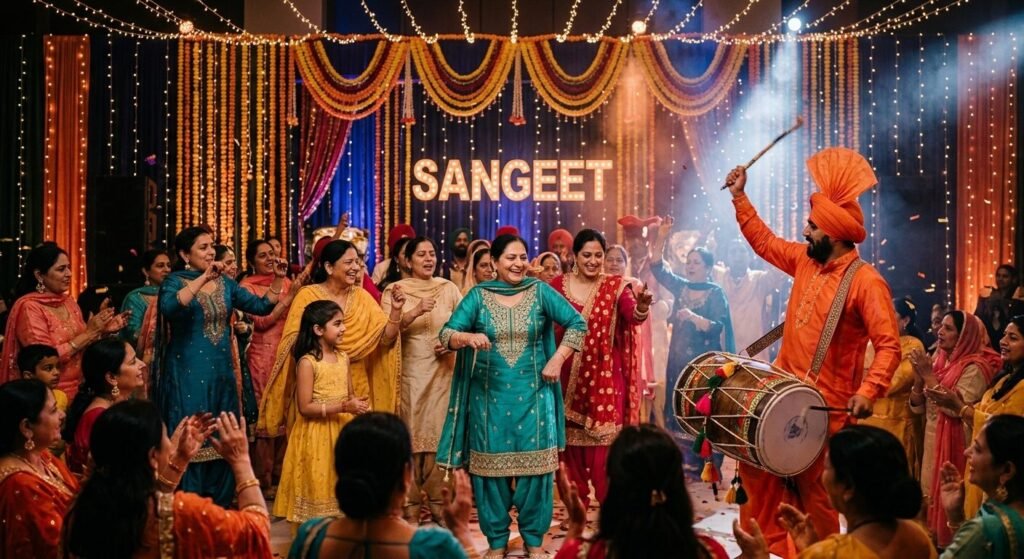
The Sangeet is usually the most elaborate and energetic event of a Punjabi wedding — a night of choreographed dances, family performances, dhol beats, and often a stage set-up with professional lighting. Both families participate, sometimes competitively, and it’s common for the bride and groom to have their own entrance performances. This is where our cinematic film coverage really comes into its own: multiple camera angles, slow-motion sequences for entrances, and audio capture of live music, so the final film feels like a genuine highlight reel rather than a static recording of a stage show. Photographically, we focus on capturing the energy of the crowd as much as the performers — the shared laughter between cousins, the parents watching from the side, the moments before someone steps on stage.
Sangeet — The Big Night of Music and Dance
Jaggo — The Night Before, With Pots and Lanterns
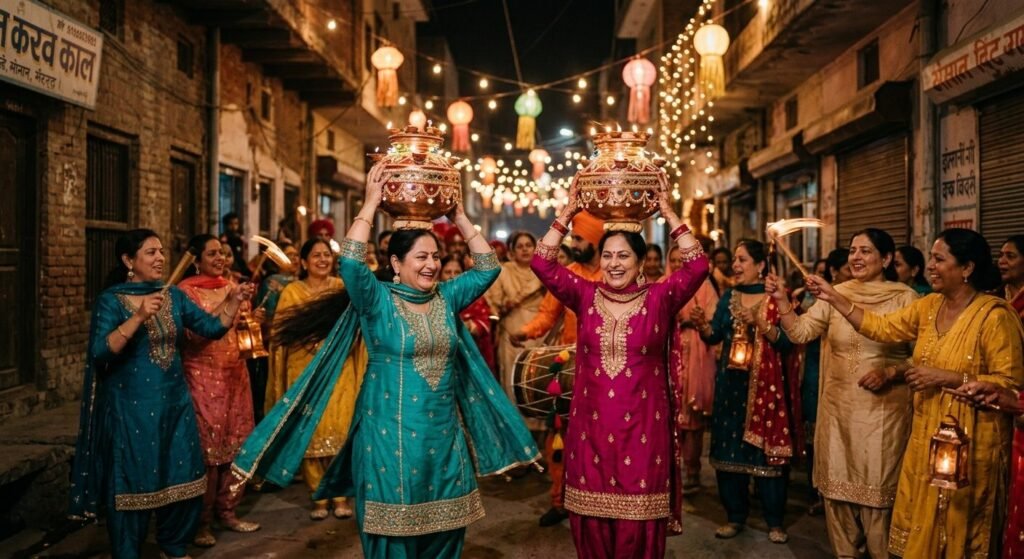
The Jaggo, held a night or two before the wedding, is a joyous, informal procession where family members — often carrying decorated pots (gaggar) balanced on their heads, lit with small lamps — dance through the neighbourhood singing traditional songs, essentially announcing the wedding to the community. It’s high-energy, mobile, and happens mostly outdoors or on the street, which makes it one of the more logistically interesting rituals to shoot. We use lightweight, mobile setups for Jaggo coverage, moving with the procession rather than shooting from a fixed point, to capture the movement and spontaneity that defines it.
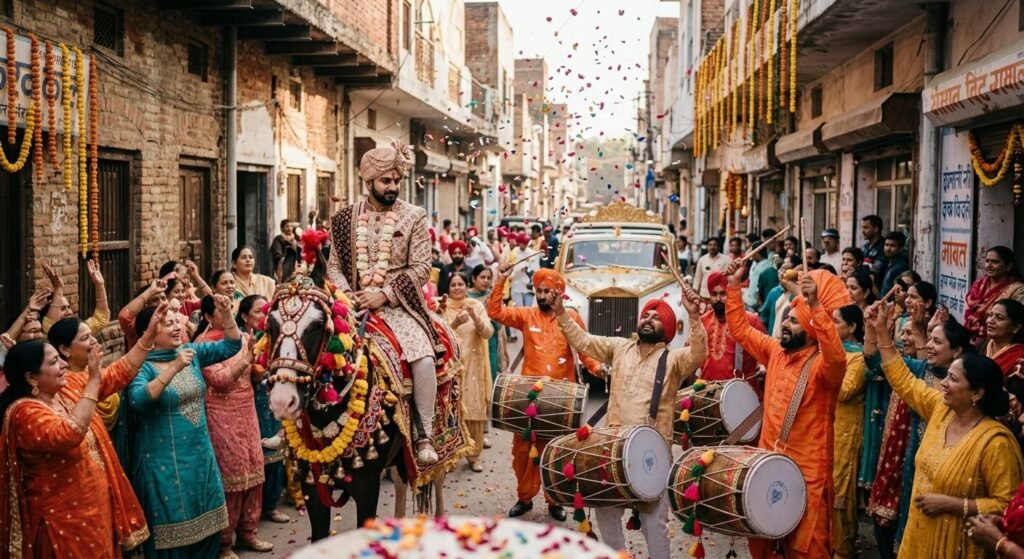
The Baraat is the groom’s processional arrival at the wedding venue, typically on a decorated horse or in an ornate vehicle, accompanied by dhol players, dancing relatives, and sometimes fireworks or confetti. It’s loud, celebratory, and often the first big “public” moment of the wedding day. This is immediately followed by the Milni, a formal, ritualised introduction where corresponding members of both families — fathers, uncles, brothers — greet each other with garlands and embraces, in a specific order of seniority. We cover the Baraat with wide, high-energy shots that capture the scale and noise of the procession, then shift to tighter, more composed framing for the Milni, where the ritual order and individual greetings matter and deserve to be recorded clearly.
Baraat and Milni — The Groom's Arrival
Anand Karaj — The Sacred Ceremony
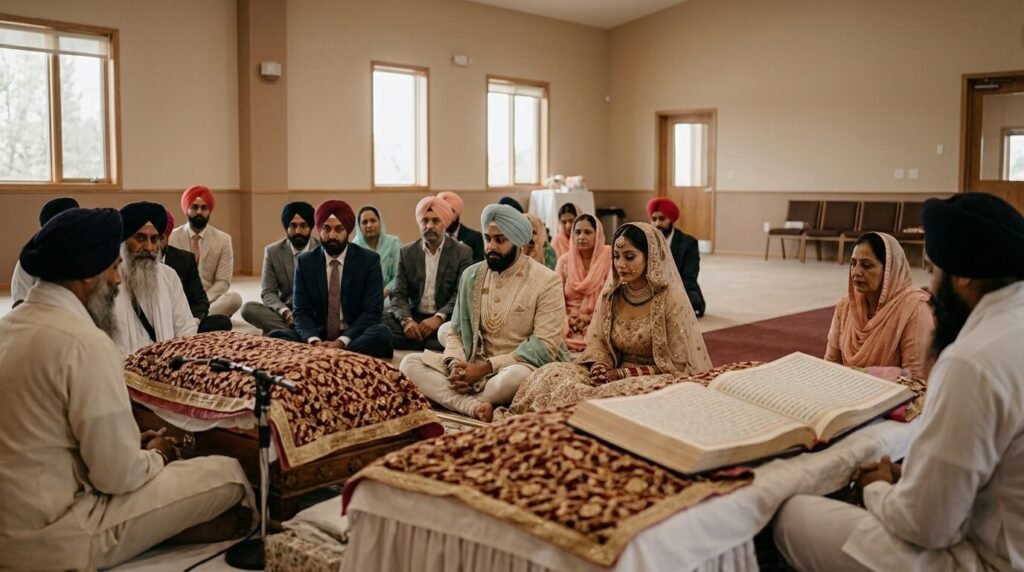
The Anand Karaj is the actual marriage ceremony, held in a Gurdwara or a dedicated mandap space, centred around the couple circling the Guru Granth Sahib four times (the Laavan) while hymns are recited. It’s solemn, spiritually significant, and quite different in tone from the celebratory events around it — hushed, reverent, and deeply personal even amid a large gathering. We shoot the Anand Karaj with minimal movement and no flash, positioning ourselves to capture the couple’s expressions during each round of the Laavan, the reactions of parents watching, and the overall atmosphere of the Gurdwara, all without disrupting the sanctity of the ceremony.
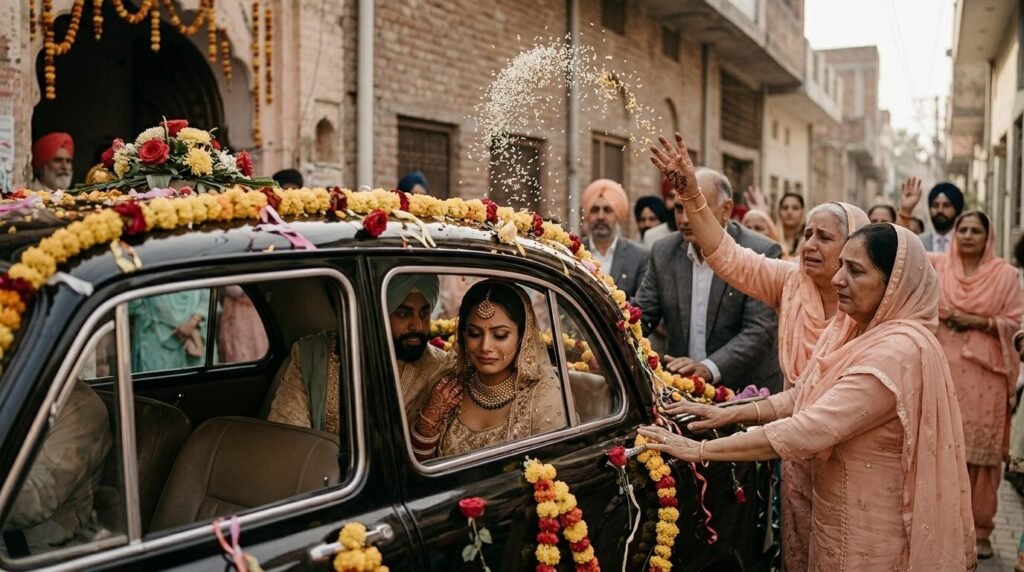
The Doli is the ceremonial departure of the bride from her family home, traditionally as her brothers push the car or palanquin she’s seated in, and rice is thrown backward over her shoulder as a blessing for her family’s continued prosperity. It’s widely considered the most emotional moment of a Punjabi wedding — the point where celebration gives way, briefly, to grief and love intertwined, as the bride says goodbye to her parents and siblings. We treat the Doli with particular care: no direction, no repeated shots, no interruption. This is a moment we document exactly as it happens, because it’s usually the one families say meant the most to have on film.
Doli — The Bride's Farewell
Reception and Muklawa — The Celebration Continues
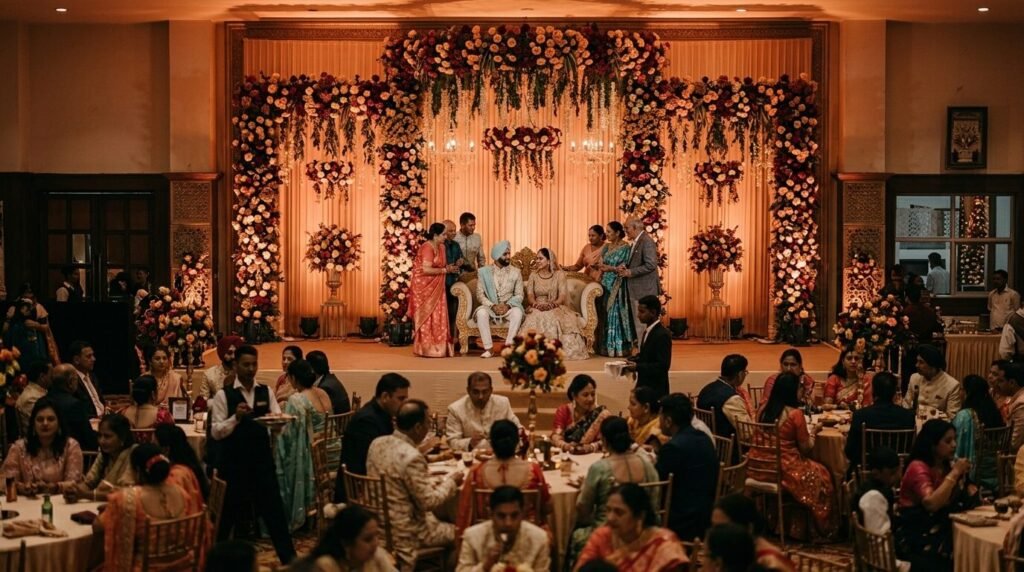
The wedding reception, hosted by either or both families, is typically a large, more formal event with a stage, elaborate décor, and speeches, followed weeks or months later by the Muklawa — the bride’s formal welcome to her new home. We offer coverage for both, treating the reception with the same cinematic approach as the Sangeet, and the Muklawa with the same intimate, documentary style as the Roka, since it closes the same story that began there.
Our Approach to Punjabi Wedding Photography
A Punjabi wedding moves fast, across multiple locations and over several days, often with two or three overlapping events happening on the same day. Our approach is built around that reality:
- Multi-day, multi-location coverage — from the Roka at a family home to a Baraat that starts on one street and ends at a banquet hall, we plan logistics around the actual flow of your specific wedding, not a generic template.
- A team that blends in — we work like guests, not a crew standing between you and your family. This is especially important during emotionally heavy moments like the Doli and the Anand Karaj.
- Cinematic wedding films — full 4K coverage with slow-motion sequences for entrances, ambient audio capture of live dhol and music, and edited films that feel like a story rather than a highlight reel stitched from clips.
- Editorial couple portraits — a dedicated portrait session, usually scheduled around the Sangeet or reception, styled for a premium, magazine-quality look rather than the usual stiff studio poses.
- Complete ritual documentation — because Punjabi weddings involve so many distinct ceremonies, we build a shot list around each one specifically, so nothing gets missed in the rush between events.
What Couples Say
Frequently Asked Questions
How many days does a typical Punjabi wedding need photography coverage for?
Most Punjabi weddings run across three to five distinct events — Sangeet, Haldi, Baraat and Anand Karaj, and a reception — sometimes spread over several days. We recommend planning coverage around each event individually rather than a single flat “wedding day” package, since the Sangeet alone often needs as much attention as the ceremony itself.
Can you cover rituals that happen at different homes on the same day?
Yes — this is common with Punjabi weddings, where the Haldi might happen at the bride’s home while a related ritual happens at the groom’s. We plan a two-team or staggered shooting schedule in advance for exactly this scenario.
How soon after the wedding do we receive our photos and film?
Edited photo previews are typically shared within a few days, with the full gallery and cinematic film delivered on a timeline we confirm before the wedding, based on the scope of coverage.
Do you also photograph the Muklawa separately?
Yes, we offer separate coverage for the Muklawa, since it often happens weeks or months after the main wedding and deserves its own documentation rather than being treated as an afterthought.
Ready to Capture Your Punjabi Wedding, Ritual by Ritual? Let’s Script Your Story.